

If you’ve lived on the block for even a limited period of time, you know about John, who has a white beard and is in a wheelchair, regularly around the southwest corner of 29th Street & 10th Avenue. We get write-ins pretty frequently about John, which are generally to the effect of “someone really needs to do something about this.” So let’s talk about John and the homeless situation.
John has been on or at least around the block for as long as the organizer of this association, which is coming up on 7 years now. That should tell you immediately that there is not an easy solution coming here. John will tell you there is a pretty simple reason why he is on the streets rather than in a shelter: he wants to be. He describes the city shelters as “nasty,” potentially dangerous, and an administrative headache—they require him to go to an intake system in the East Village, which then spits him out wherever there is shelter availability. John does not have legs and so you draw the inference that if a shelter is a little dangerous for most, it is very dangerous for him.
This all tracks a basic distinction between what I’ll refer to as transitional homelessness and chronic homelessness (keep in mind that I am just some guy and not an expert on this). The former refers to people who are on the street because they are temporarily down and out (e.g., they lost a job) and the latter refers to people who have been on the street for a year or longer. The issue with the latter often comes down to one of the more basic laws of human nature: you usually cannot change someone unless they actually want to change. If you talk to the chronically homeless or people who regularly interact with them, you will quickly find out that this latter group is often on the streets because they want, in some sense, to be on the streets. Many have mental health issues, and on top of it, like John, many view shelters as more dangerous or otherwise less favorable than the streets. So unless you’re ready to involuntarily commit people to a shelter—and involuntary commitment is really only a thing in our city if someone is presenting a serious harm to themselves or others—we really do not have any good options. So in a sentence: it is not as though we just have to tell or even show John there is a shelter available somewhere.
So what do we do about this? You are certainly free to call 311, which will trigger NYC homeless outreach personnel to approach John within one hour and “encourage the person to accept services.” You can also do your homework and read about cities that have sort of “solved” the homeless problem, including Denver, which has essentially built clean, safe housing for homeless residents and used the police to rather pointedly direct them to those residences. I do not know if the Denver solution is feasible for New York, but if it is, it isn’t coming any time soon.
So like, what can we actually do about this?
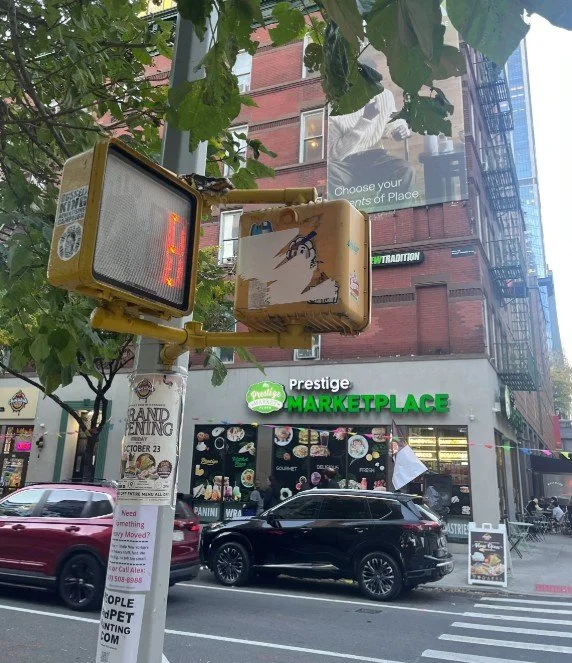
I don’t know, and neither do you, and neither does John. So we’re all sort of in this together. While we’re all here in this time and space, the other thing you should know about Neighbor John is the following: his favorite sandwich is a hot ham and cheese on a hero with spicy mustard and nothing else on it (no lettuce, tomatoes, onions, etc.), and he takes his coffee with five sugars and a little bit of cream. You can get all of these things at Prestige Marketplace on the northwest corner of 29th Street & 10th Avenue. He’s used to how they make it there.